Do As I Say AND As I Do

Sharing by Flickr User Ryan Roberts, CC License = Attribution, Noncommercial
Click image to open new tab/window to view original image and to access user’s full photo stream at Flickr.
Why didn’t the clam want to share his lunch? Because, he was a little shellfish. I have never read anything that would make selfishness sound like a pretty thing, but there are plenty of pictures (like the one above), and stories, that demonstrate the beauty of sharing. I think we have a built-in desire to share, which is why the stories touch us so deeply. And I think it is that natural desire to share that makes social media so profitable because we can share without a monetary cost to ourselves. We don’t only share for what we can get back, but I think most of us find it easier to share with givers than with those who do nothing but take, take, take. As Scripture says in Luke 6:38 (New Living Testament)…
Give, and you will receive. Your gift will return to you in full—pressed down, shaken together to make room for more, running over, and poured into your lap. The amount you give will determine the amount you get back.
In today’s reading from Leviticus 10:12 through Leviticus 10:15, we read of God’s example of sharing. Moses tells Aaron and his sons to eat the especially holy part of the grain offering by the altar, and he explains that it is the priests share. He then tells them to eat their share of the wave offering in a clean place. He says that offering is also to be shared with their Aaron’s daughters, and with the rest of the family. He goes on to explain that these portions of the offerings are to be their shared portions perpetually.
See, these were offerings given to God, but He made sure a portion of them was given back. He set the example of only taking to give, just as He set that example in nature with the way it regenerates. And I believe He is the one who put it into our hearts to give something back whenever we receive something–even if it is only our gift of thanks to the giver. He gave us His word that we can do as He says, and He gave us His example that we can do as he does. That’s why we play Follow the Leader and not Follow the Dictator. Let us lead by example as He led by example that the whole world may know the beauty of Our Awesome Creator.
I’ve shared a picture with part of this writing from Ellen G White before, but it seems appropriate again, so enjoy this beautiful portion of a chapter from her book The Desire of Ages…
Now sin has marred God’s perfect work, yet that handwriting remains. Even now all created things declare the glory of His excellence. There is nothing, save the selfish heart of man, that lives unto itself. No bird that cleaves the air, no animal that moves upon the ground, but ministers to some other life. There is no leaf of the forest, or lowly blade of grass, but has its ministry. Every tree and shrub and leaf pours forth that element of life without which neither man nor animal could live; and man and animal, in turn, minister to the life of tree and shrub and leaf. The flowers breathe fragrance and unfold their beauty in blessing to the world. The sun sheds its light to gladden a thousand worlds. The ocean, itself the source of all our springs and fountains, receives the streams from every land, but takes to give. The mists ascending from its bosom fall in showers to water the earth, that it may bring forth and bud.
The angels of glory find their joy in giving,–giving love and tireless watchcare to souls that are fallen and unholy. Heavenly beings woo the hearts of men; they bring to this dark world light from the courts above; by gentle and patient ministry they move upon the human spirit, to bring the lost into a fellowship with Christ which is even closer than they themselves can know.
Share this post on:

God’s Blessings Ready You for God’s Presence
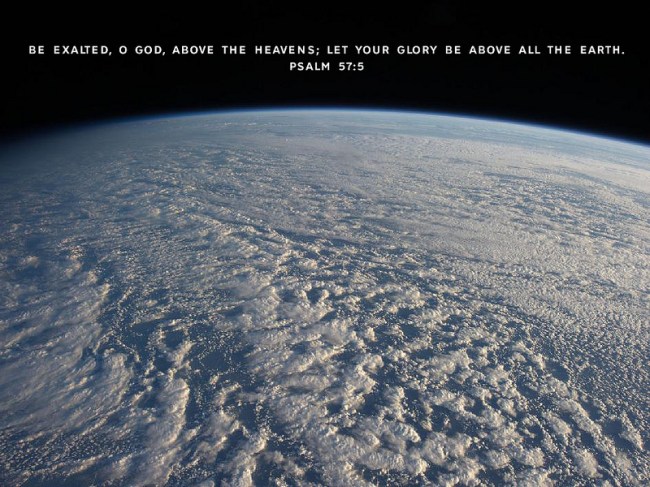
Above the Earth by Flickr User thoughtquotient.com, CC License = Attribution, Noncommercial, No Derivative Works
Click image to open new tab/window to view original image and to access user’s full photo stream at Flickr.
A seed doesn’t grow just because you plant it. It must be planted in ready soil. And, if the seed is to grow to maturity, the soil must be maintained for growth. Maintenance may come in the form of watering, weeding, and/or nutrients, but rarely does something left to itself grow to the best it can be. This is only part of the law of the harvest, and since we are made from earth, it’s important that we understand the part the harvest plays in us.
In today’s reading from Leviticus 9:17 through Leviticus 9:23, we continue the events of the eighth day from the beginning of the consecration of Aaron and his sons as priests for Yahveh. They offer a grain offering, and a portion of it goes up in smoke on the altar. Then they bring peace offerings and wave offerings as Moses directs them. And then Aaron comes down from offering the sin offering, the burnt offering, and the peace offerings, and he blesses the people. After he blesses the people, Moses and Aaron go back into the Tent of Meeting, come out again, and bless the people once more. AND THEN (my emphasis), God’s glory appeared to all the people.
If God planned to show His glory to the people anyway, why didn’t He just meet them as soon as they had all gathered? If it was because of sin, then why didn’t He meet them as soon as the offerings were completed? I believe this all comes back to the law of the harvest. Just because soil looks ready, doesn’t mean it is. Only those who work with soil for a living would know if it is actually ready for the specific seed to be planted. God knew the order of things that would make His people ready to receive His glory. He knew which offerings should be completed, and which blessings should be spoken over the people, to prepare them for God’s holy presence.
These days, we have preachers who just bless people because that’s what the people want to hear. There are many who never go into a holy place with God to consult Him before dishing out blessings, and they don’t give the blessings for the purpose of God’s presence as much as for the thanks of the people. In what way does telling someone that God is about to bless them with a big house and a new car prepare them to commune with God? I imagine what they called blessings in these Scriptures were something more along the lines of, “The sacrifice has been accepted, and you are purified to receive God.” And after Moses and Aaron came out from meeting with God, they might have said something like, “God has looked upon your hearts and sees your desires for Him, so now He will meet with you.” I mean, truly, can you think of a better blessing than that?
Even under the blood of Christ, there is a plan and a pattern. If there was not one, then we would not even need the written word beyond the story of crucifixion and redemption. The blood of Our Savior is the sin offering, but where are we in the other offerings and sacrifices? I believe WE are to give ourselves as an offering to God to allow Him to prepare us for His presence. We bring sacrifices of confession, humility, repentance, and accountability. We may offer a sacrifice of praise as our wave offering. And in all the sacrifices and praise we give, and in all the blessings we receive, we should strive for those that are holy and acceptable to Yahveh, and for those that prepare us for God’s holy presence in every moment of our lives.
Share this post on:

My Latest Flickr Photos


Others’ Posts I’ve Liked


 Crystal Writes A Blog
When Brothers Weep
Sorrow by Flickr User Daniel Waters, Co. Sligo, Ireland, CC License = Attribution
Click image to open new tab/window to view original image and to access user’s full photo stream at Flickr.
Sadness and sorrow are strong emotions that can change moments, days, weeks, and longer parts of our lives. When the sorrow is generated by a painful situation involving someone we care about, it can affect everything from appetite to moving forward in our daily routines.
In today’s reading from Leviticus 10:16 through Leviticus 10:20 (the end of the chapter), we read about the effects of sorrow on Aaron and his remaining sons after two of his sons were killed for offering strange fire on God’s holy altar. I found it just a little harder to understand from the Complete Jewish Bible, so I recommend also reading from another version as well. Here’s a link to read today’s portion from The Amplified Bible…Leviticus 10:16-20.
So Moses is checking up on the rituals he has trained the new priests to perform, and he is concerned that he cannot find the meat from the sacrificial goat. The priests were supposed to eat the meat in a holy place as their portion of the sacrifice, but Moses discovers that they have burnt it up as waste instead. He asks them why they did things their own way instead of God’s way, and why the blood was not brought into the holy place as Moses commanded.
The response from Aaron is basically something along the lines of, “After what happened to the other two members of our family, we were all depressed and had no appetite.” And then he asks Moses if God would have been pleased with them if they had gone ahead and eaten in spite of what they had just been through. Upon seeing that perspective, Moses is pacified and understands the sorrow of the men.
I understand the pain of these brothers and father too. When I see a perspective that shows me the sorrow of others, I have to fight feeling sorrow myself–even for something as far back as a story in the Old Testament. I cry so easily that I wept when I thought of my kitties going under anesthesia for being fixed and not having anyone there who could explain in kitty cat language what was happening to them. Today, when I heard the family members weeping for their relatives who were passengers on the lost Malaysian Airlines jet, I immediately felt their pain and began to cry. I am highly sensitive to the emotions of others, and that can be both a good and bad thing at times.
While the brothers and father in our Bible story were experiencing common mourning, what I have described about myself is a bit less common. There is a great article (lens) on “Squidoo” that describes it perfectly. It’s called The Empath Within–Are You A Highly Sensitive Person, and it explains what it means to be empathic rather than just empathetic. It helped me to understand why something like a trip to Walmart can make me feel so emotionally drained, and it has to do with the sensations I feel from the huge mix of emotions there. I highly recommend the article.
So, why am I tying the sorrow of today’s story to my own empathic spirit? Because it’s a great segue to explain to my readers why the world sometimes feels like too much for you to bear. If you’re like me, when there’s a lot of pain around you, it makes it hard to complete even basic tasks. You’ll understand if you click on the article above, and you’ll even get a bit of a better understanding of me as a person.
Of course, the hardest thing of all is feeling stuff the rest of the world either doesn’t feel or won’t admit to, or maybe feeling things differently than the rest of the world thinks I should feel them. For example, while I am hurting over my nephew who is still not waking up, I feel more sadness for some of my Facebook friends who are battling cancer because I know they did not bring it onto themselves. Yes, I want Joshua to be healed, but if I had to choose only one person to receive a miracle, I would hand it to my friend, Judy Sliger, who is at the end of anything doctors can do in her battle with ovarian cancer. That brings its own kind of pain because I want to take on everything for everyone, but no one other than Our Savior was ever built for that task, so I’m left with fighting guilt.
I will ask you, my lovely readers, to continue to pray for my nephew. I ask above all else that you pray for God’s most perfect will to be done, and that you pray for God to be glorified in the situation. I would love to know that God is somewhere with him in that comatose state, and that he will wake up as a servant of God who is ready to tell the whole world about it. And I also ask you to pray for the many on my heart for the cancers and sicknesses and pains they are going through.
I will end today’s post with this: Judy is one I have known and met as we worked together to plan the Kentucky Christian Writer’s Conference some years back. She has written a book about her struggle with cancer. So, if you want to support her, or if you know anyone else who is fighting a terminal condition, I encourage you to consider purchasing her book. You can visit by clicking on this title… Take Heart: Prayers for the Terminally Ill. (This is a direct link to the paperback with no affiliate link embedded.) Thank you, and may your days ahead be blessed with more positive emotions than negative ones, and more and more of God’s presence as you continuously draw nearer to Him.
Share this post on:
March 19, 2014 Posted by Crystal A Murray (aka CrystalWriter) | Bible Study, Nonfiction, Torah Commentary | Aaron, Adonai, Almighty, Bible, Bible Gateway, Bible reading, Bible study, Complete Jewish Bible, Creator, crystalwriter, empath, empathy, God, high priest, Holy Bible, Leviticus, Lord, Moses, mourning, obedience, offerings, Old Covenant, Old Testament, Parashah, Portions, priests, sacrifices, sadness, Scripture, sorrow, terminal illness, The Complete Jewish Bible, Torah, Torah commentary, Torah Portions, Torah Reading, Word, Word of God, Word of the Lord, www.biblegateway.com, Yahveh, Yahweh | 5 Comments