Crossing Jordan

The River Jordan by Flickr User Cycling Man; CC License = Attribution, NonCommerical, No Derivatives
Click image to open original in new tab and access this user’s photo stream.
As you can see by the image, I’m not talking about the television show, but since I recognized the title, I at least looked it up. It looks like an interesting premise for a show, so if anyone has seen it and thinks I should check Netflix for it, let me know. 🙂
But I think I did learn from today’s reading of Genesis 49:27 through Genesis 50:20 why we associate death with crossing the Jordan River. Before I get to that part though, there were only 11 sons covered in the last two posts, so we do have one more son’s prophecy; the youngest son, Benjamin. Jacob’s words to him were that he was a ravenous wolf that would devour prey during the day and divide the spoils by night. After saying that, he concluded what Scripture calls blessings on his twelve sons. Well, honesty can be a blessing because it can make you aware when you’re heading down a dangerous path, but for it to truly be a blessing, the receiver will have to see it that way and determine how to use it as such. Like a wet paint sign that can keep you from getting stained by touching the stuff, once you see the truth, you must make a decision to use it for the best outcome.
When Jacob finished speaking, he gathered his legs underneath him and drew his last breath. Joseph ordered the physicians to embalm him, which took 40 days, and then the Egyptians mourned him for 70 days. When all was said and done, Joseph told Pharaoh of the promise he made to take his father to be buried in the cave with Abraham and others, so Pharaoh sent him, his family, and most of his servants to carry Jacob back to the land of Canaan beyond the Jordan river. That they were crossing Jordan to bury someone is what made me think that this is why we associate death with crossing the chilly Jordan, but I’m not sure, so it’s just my thought.
After they crossed into Canaan, the residents of the land saw that the Egyptians were weeping bitterly over the loss, so they named the place Abel-Mizrayim meaning “mourning of Egypt.” I know they had paid mourners and such back then, but it seems that this mourning was very real even though the Egyptians did not know Jacob that long. I’ve heard it said that the best way to live is to care so much about others that when you die, even the mortician is sad that you’re gone. I think Jacob lived that way.
Once the burial was done, they crossed back over Jordan, and Joseph and his brothers returned to live in the land of Goshen in Egypt. When they got back though, Joseph’s brothers started thinking that with their father gone, Joseph would surely try to make them pay for what they had done to him. They apparently did not believe what he said to them the first time, so he restated to them that even though they meant what they did for evil, God used it for good. He reminded them that he was not God, and it was not his place to take vengeance on them. Hopefully, then, they repented to God for their behaviors with the same trembling and humility with which they went to their brother. That’s a good thing to do before crossing Jordan in the spiritual sense.
Share this post on:

The Future of Israel–Part II

12 Tribes of Israel Mosaic by Flickr User Zeevveez
Click the image to visit this user’s photo stream. He has interesting blogs and books on the Star of David and have even blogged on some of my 6 point kaleidoscope images.
As I’ve read these prophesies of Jacob to his sons, I’ve thought much about the power of words, but there’s more than words involved. Jacob may have had special feelings toward the children of Rachel, but these were all his sons, so I’m guessing that whatever he spoke to them was spoken with parental love. We are told in multiple Scriptures that God chastens those who He loves, so even the words that seem painful to the receivers are from a father’s heart. And so it is with those of us who call Yahveh our Father. Sometimes, He may give us words that promise futures we may not want to go through, but we know we never go through those futures alone, and we never go through them without promise that they will yield some type of fruit to the glory of God.
Four more sons are discussed in today’s reading from Genesis 49:19 through Genesis 49:26. The sons discussed in today’s reading are Gad, Asher, Naphtali, and Joseph. When you read these verses, and yesterday’s verses, in the Complete Jewish Bible, you’ll notice that most of the brothers get their own paragraphs, so it’s easy to tell which ones Jacob spoke of more than others. Of these four brothers, the first three get very little prophesy, but Joseph gets a lot.
In brief, Jacob says that Gad will be attacked, but he will attack in return and be victorious. Asher will produce plenty of food, including that which is considered for royalty. Naphtali is a free-running deer that produces beautiful fawns. Also, it’s possible that the prophesy of Naphtali is that rather than fawns, he will produce great writings. Of course, I like that one for a prophecy. 🙂
The rest of the writing focuses on Joseph. It says he is a fruitful branch by a well whose leaves reach over the wall. I see this as a tree planted by the water, so that speaks of strength, and a bearing a lot of fruit if the branch would hang down over a wall. Since Ephraim is said to represent “the church,” this could be prophesy of those of us reading this who are believers and servants of God now. How cool is that?
It goes on to talk about Joseph being attacked unfairly but that he was separated from his brothers to become a prince among them. Jacob even speaks the blessings of The Lord upon Joseph as being greater blessings than those that were upon his forefathers Abraham and Isaac. Considering the later prophesy when Ephraim will be united with Judah, I’d say Jacob’s words were certainly true.
I will go back and add the details for yesterday’s brothers now, but I wanted to get this post done and added before midnight.
Share this post on:

The Future of Israel–Part I

12 Tribes Road Signs by Flickr User Zeevveez
Click the image to visit this user’s photo stream. He has interesting blogs and books on the Star of David and have even blogged on some of my 6 point kaleidoscope images.
Today’s reading from Genesis 49:1 through Genesis 49:18 covers the prophecies from Israel to the first seven of his sons. Those written of here were Reuben, Simeon, Levi, Judah, Zebulun, Isaachar, and Dan. Not all of the prophecies for the futures of these sons look like blessings, so I imagine that some of them were hard for Jacob to speak to them. It’s always hard for parents to tell their children the truth, but the lack of truth will do more harm than good, so it’s one of those necessary things. Of course, speaking the future as something negative and without hope may not be the best way to encourage someone either, so it goes back to a saying I heard many years ago, and something I suggest people apply when editing writing for others: Honesty without compassion is cruelty. You’ll have to read it for yourself to decide if the words are honest and compassionate or just honest.
I am actually finishing this post a day later because it was important to me to spend time on the phone with my uncle from Arizona. He was celebrating his 65th birthday, but we also had a lot to talk about concerning his son, my first cousin, who is younger than me but has suffered first from a bad bout of “Valley Fever” (a fungal lung infection that required multiple surgeries), and then suffered two strokes. He’s younger than me, and strokes don’t run in the family, so we think they were side effects of the Fluconozole they put him on for the infection, but regardless of the cause, he has been hospitalized since March. Please keep Chance Robertson in your prayers, not only for physical healing, but that he will use these events to make God the most important part of his life. My uncle has a neighbor who has been bringing Scriptures to him since he has been able to read again, and my uncle is in a place where he prays a lot and says he is willing to change in whatever ways God directs him. That is a great change and blessing to my heart, and it brings me right into what was going on with Jacob and his sons.
I’m sure Jacob would like to have said nothing but good to each of his sons, as any parent would like to do with their children. And I’m sure that even with the news that didn’t seem so good, he would like to have said that each of them would have an opportunity to repent and get it right. Of course, we don’t really know if there was more said, and it is my hope that those who made bad decisions did so with open eyes and minds if they chose to reject God.
So, in brief, Jacob said that Reuben was his first born and the strength of his first offspring, but because he had no self-control and climbed into his father’s bed with one of his concubines, he lost ground and would not have the full strength he should have had. This is the one that bothers me the most because I always hurt for those bad decisions that have consequences that cannot be taken back. All the repentance in the world cannot remove a child conceived by an illicit sexual relationship, and really we should look at the fruit of every sinful seed we plant in this light. We do not receive the true price for our sins (the wages of sin is death) if we give them over to Christ, but they still bear fruit we need to consider. In this case, Reuben missed out on strength he could have had.
Jacob also speaks to Simeon and Levi of losing out because of their uncontrolled anger. They plotted together to kill a man in anger (for raping their sister), but it also says they were cruel and killed animals. Yikes! Their price is being scattered and divided.
Next we get 5 verses on Judah. Remember that our Messiah Yahshua (Jesus) is The Lion of the Tribe of Judah. Verse 9 speaks of him as a lion’s cub, a lioness, and a lion on a mountain with prey. The next verse says he will lead and rule until “Shiloh” (meaning Messiah or the peaceful one so the word might actually be another use of “Shalom”) will come from him. It goes on to say people would obey this leadership. Verse 11 seems prophetic of Yahshua in that it says his colt will be tied to a vine (see Mark 11:2 just before the triumphal entry into Jerusalem). It goes on to say that his clothes will be washed in wine and in the blood of grapes. Of course, I’m not sure of the ending words to him of his eyes being darker and more sparkling than wine & his teeth whiter than milk.
The word to Zebulun is that he would be a harbor for lost ships; to Isaachar that he would be a strong donkey crouching between sheepfolds (maybe the Messianic Jews, but I can’t say since I’m not a trained scholar); and to Dan that he would be a judge of his people and a horned snake in the path. Maybe someday, if I remember once I’m in God’s presence for eternity, I’ll ask what some of these prophesies represent, but in the meantime, I’ll be satisfied to receive only what God thinks I need to know. Still, I will search because of what it says in Proverbs 25:2 that it is the glory of God to conceal a matter but the glory of kings to search it out.
Share this post on:

The Lord is My Own Personal Shepherd
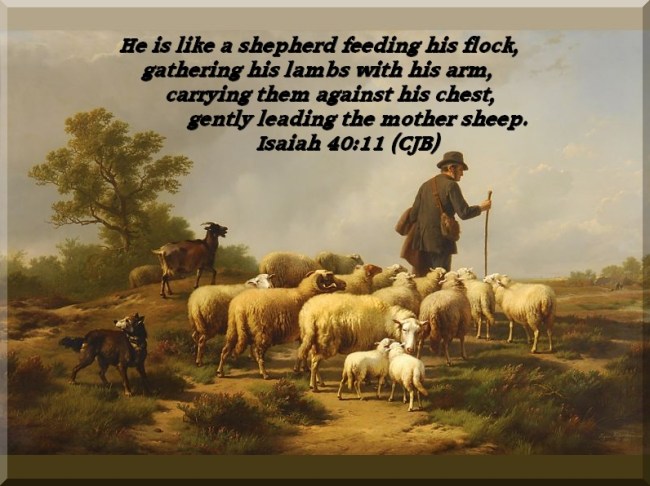
Shepherd with Flock by Flickr User Will Humes CC License = Attribution, NonCommercial, Share Alike
Scripture from Isaiah 40:11 from Complete Jewish Bible
Click image to open new tab to the original image and access to photo stream.
I can share all kinds of stories and Bible words with you, but the thing that carries the most strength is what God means to me personally. The most established scholar cannot compete with the actual testimonies of my life with God. Of course, there must be balance in that my testimonies about God should be supported by His word to show that I am actually following Him and not just my own ideas. If I am following Him as my Shepherd, I will go where He goes and try to imitate what He does.
Today’s reading from Genesis 48:10 through Genesis 48:16 goes back to Jacob/Israel on his death bed as he prepares to bless the sons of Joseph. He was having trouble seeing, but Joseph brought his sons close enough to him that he could see and embrace them. He praised God for allowing him to not only see his son again but also to see his offspring.
Joseph guided his eldest, Manasseh, to Israel’s right hand and his youngest, Ephraim, to Israel’s left hand for their blessings. But Israel purposely crossed his arms and placed his right hand on Ephraim’s head and his left hand on Manasseh. He began his prayer for them with a beautiful statement that Yahveh Almighty had always been his own Shepherd.
I love the personalization in that. He not only proclaimed Yahveh as God of all the offspring of Abraham, Isaac, and himself, but by proclaiming Him as a shepherd, he declared himself to be a sheep that needed guidance. And, because he and his family were a family of shepherds, Jacob also connected to God in similarity of occupation. He knew God as both above him and with him in all things. As a matter of fact, there is a Scripture in Deuteronomy that I want to share now even though we will eventually get there in the studies. It’s from Deuteronomy 4:7, and in the Amplified Bible it says, “For what great nation is there who has a god so near to them as the Lord our God is to us in all things for which we call upon Him?”
There are many Scriptures that proclaim God as a shepherd, including the one on the above picture. The most famous, of course, is David’s Psalm 23. To personalize that Psalm, back in 2004, I wrote my own version of the psalm as attributed to myself as a writer. I’ll close this with that parody.
THE LORD IS MY EDITOR, I SHALL REWRITE By Crystal A Murray The Lord is My Editor, I shall rewrite. He lays me down in green pastures – Of fresh ideas. He leads me by the quiet torrents – Of conflict and resolution. He develops my characters and subjects. He leads me from beginnings to middles… – And from middles to endings… – For the plot’s sake. Yea, though my protagonist walks Through pages of shadows of death, – He fears not the antagonist, – For a good ending is promised. God’s red pen and word-processor; – They correct me. God prepares new writers’ books before me, – In the presence of my Amazon “wish list”. He anoints my printer with ink, – My paper tray overflows. Surely, acceptance and paychecks – Shall be offered me, – For every story I write. And I shall dwell in my home office – As a freelancer… – All the days of my writing life.
Share this post on:

When I Get Carried Away

Carrying Away a Dead End by Flickr User “The Hamster Factor”
Click the image to open a new tab with the original image and access to photo stream.
I never know what I’m going to find when I do a Creative Commons search for an image that will match my title or subject. The above image just tickled my funny bone, so I had to include it. I know people aren’t supposed to deface public signage, but this one is just too cute, and it sort of lines up with the reading today from Genesis 47:28 through Genesis 48:9 as it talks about Jacob being carried away to his death, and the line could look a little like a coffin. 🙂
We actually begin a new portion today, so now we’re up to Parashah 12, Vayechi, meaning “He Lived” in Hebrew. We read in this section that Jacob has now lived in Egypt for 17 years which makes him 147 since he was 130 when they arrived. He calls in his son Joseph to advise him that he will soon pass away and to ask him for a promise. He wants Joseph to swear that he will not bury him in Egypt but rather carry him back to Canaan to be buried with his family, and Joseph agrees.
The next part is a little confusing to me in that he claims Joseph’s two children, Manasseh and Ephraim as his own children. He says they are equal with the rest of his children for the sake of inheritance, and they are numbered among the twelve tribes to this day even though Joseph is not. I know there is some prophecy about it later, so I know it was the right thing to do, but there’s no information at this point to explain exactly how Jacob knew to do it. I can only imagine it has something to do with his vision of Yahveh back in Luz near the time he was there with Joseph’s mother, Rachel. He retells this vision to Joseph, and he tells him that all his future children will be his, but not the two.
The section ends with Jacob suddenly noticing that Joseph’s sons are standing there in the room with them. I might have been embarrassed to realize that someone I was talking about was standing there all along, even if I was saying good things about the person. I remember asking for prayer for a young man I met at a bus stop, and finding out that he had accepted my invitation to attend a service when the pastor pointed out the guy a few rows back slinking down in his seat. Oh well, at least he knew I cared enough to ask the church to pray for him, right?
So that’s it for today, but just to stick with the theme, here’s a link for a video of a group singing the song When I Get Carried Away. I love the tune, and the lyrics to the chorus are…
I’m gonna let the glory roll when the roll is called in glory. I’m gonna get beside myself when I get beside The King that day. I’m gonna have the time of my life when the time of my life is over. I’m gonna get carried away, when I get carried away.http://www.youtube.com/watch?v=3afLiU-jieM
Share this post on:

Will Work as a Slave for Food
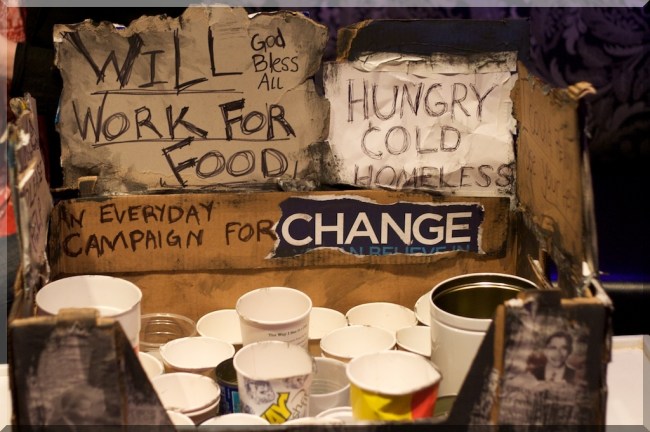
Will Work for Food signs by Flickr User Aaron Brazell aka Technosailor
Click image to view original & access photo stream in new tab.
While I never held a sign by the side of the road, I have been both homeless and hungry. In those days, it was a treat to find clean food at the top of a McDonald’s trash can, though now the smell of ketchup in the garbage is hard for me to deal with. Maybe it’s old vinegar, or maybe it’s old memories, but I’m thankful I survived those times without becoming a permanent slave to anyone. And I’ve been homeless more than once, even during a time when I was working and sleeping in my car in the company parking lot. I’m thankful God has delivered me from all those times, but I’m also grateful I went through them.
As this week’s portion comes to an end, we find Israel living in the best part of the land Egypt. Our reading from Genesis 47:11 through Genesis 47:27 finds the family living in Ra’amses as Pharaoh promised. Joseph feeds and cares for his father and brothers and his entire family to the youngest of them.
And then we read why the above is so important. The famine in the land had become so severe that people could not even provide money to purchase food or grain any longer. Joseph tells the people to give their cattle and flocks to Pharaoh in exchange for food. Because they didn’t want to starve, they gave up all their animals. The next year, they found the same issue, only this time the only thing they had left was their land and their own bodies. They promised their land to Pharaoh in exchange for food and for grain to plant on their property to grow more food.
Eventually, Joseph acquired all the land in Egypt for Pharaoh. As for people, they were reduced to slaves city by city. The only ones who did not have to sell their land or become slaves were the priests. They had always been provided for by Pharaoh, so it remained that way. But everyone else was so grateful for their lives that they gladly gave their all to Pharaoh and even promised twenty percent of their future prosperity to him forever.
I still hurt for anyone who is hungry and/or cold, and I know that while some things in our economy improve, others get tougher–like needing two forms of identification to get a job. You can lose a lot of financial ground while you’re trying to get the money together to order a birth certificate, wait for its arrival, and then get the money and time to go get an ID (and a social security card if you don’t have one). It’s harder still if you can’t prove an address to put on the ID. Sadly, however, I also know that there are people who make upwards of $3000 per day just by holding one of those signs, and I’ve tried to give food and work to some who have rejected it because they actually only wanted money.
I’d love to hear from readers who have experienced either side of homelessness or hunger. Do you have an inspiring story about someone who climbed up with a little help from strangers? I can tell you some amazing stories of provision from both men and from God, and I’ll be glad to share with anyone who asks. In the meantime, I’m thankful that I am able to sit here in a warm home and write this to you. It’s a huge leap from a patch of grass and using newspapers for blankets.
Share this post on:

When Egypt Thinks You’re Smelly

Shepherd and sheep dolls by Flickr user Alkelda.
Click on image to view original in a new tab and to access this user’s photo stream.
Sometimes, the negative opinions of others can play in our favor. In our reading today from Genesis 46:28 through Genesis 47:10, we see the family of Jacob arriving in the land of Goshen in Egypt. Judah went ahead as a guide, and Joseph loaded up his rig and went out to meet his father, Israel. They embraced and wept together for a long time, and Jacob declared that after seeing that Joseph was alive, he was now ready to die.
Joseph met with all his brothers and explained his plan to them. He said he would bring a few of them to Pharaoh, and that when they were asked what they did for a living, they should say that they were shepherds both now and from their ancestry. He explained that Egyptians consider shepherds disgusting, and that knowing they were a shepherding family would make certain they could stay in Goshen–I’m guessing away from the main part of town. So, Egypt’s abhorrence of shepherds would play in Israel’s favor to allow them to live from the fat of that land but away from the politics and prying eyes of the kingdom.
When the brothers and their father came before Pharaoh, everything went as planned. Pharaoh even declared that since they were professionals, they should be in charge of his flocks as well. With this, Jacob blessed Pharaoh and then he left.
I don’t know if I could make myself think of this story each time I deal with criticism, but it would be a good way to try to turn a negative into a positive. I’m always looking for the good thing that God will bring out of something because that is a way I comfort myself to make it through the hard times. To bring it out enough to bless one who may look down on me would take even more effort, but I’ll be taking this lesson to heart. As it says in Romans 8:28, All things work together for the good to those that love God and are called according to His purpose.
Share this post on:

Circumcision of Truth
Today’s reading has some pretty sensitive topics, but it’s still a part of biblical history, so we will trudge on together. Our complete reading is from Genesis 34:1 through Genesis 35:11, and it begins with the story of a man, Hamor the Hivite, who has fallen in love with Dinah, the daughter of Leah and Jacob. Now, Hamor’s son, Shechem, was also in love with Dinah and demanded that his father go get her for him.
Before Shechem shared his intentions with his father, Hamor apparently tried to win Dinah’s affections and did not succeed, so he raped and humiliated her. And then I’m wondering if maybe he thought he could hide the situation is why he was willing to go to Jacob to ask for Dinah’s hand. But Jacob knew what had happened to Dinah, though since his sons were not available, he held his tongue. When Simeon and Levi, the sons of Jacob, came in, Jacob told them the situation, and they made plans for payback.
hen Hamor offered the women of his village in exchange for the women of Jacob’s people, the boys told them they would accept the offer only if all their men would become circumcised as the men in Jacob’s family were. When Hamor brought the news to his men, he told them he thought it was a good idea because the intermarriage of the families would mean they would inherit all the riches of Jacob’s people. Both camps, it seems, circumcised the importance of truth from their lives and communications.
Finally, when Hamor’s people got circumcised physically, the sons of Jacob waited about three days until the men were in excruciating pain. Then, they took advantage of the pain and weakness of the men and attacked and killed them. After they did this, the rest of Jacob’s people and servants plundered the Hivites and took their cattle and possessions. But Jacob was angry with them and told them it was going to cause all the other people around, such as the Canaanites and Perizzites, to join forces and attack him.
God came to Jacob and told him to go back to Bethel and make his home there and to build an altar at the place where he first met God. Jacob told his people to get rid of all their false gods (I’m amazed that he knew they had them and didn’t make them get rid of them before) and to get ready to travel to Bethel. As they traveled, God put a fear on all the people of the lands they passed through so they would not harm Jacob or his people. Finally, Jacob built the altar God told him to build, and God met him once more. This time, he said he would not only be named Israel, but from that point on should also be called Israel.
In Chapter 35, verse 11, (in the Amplified Bible) we read, “And God said to him, I am God Almighty. Be fruitful and multiply; a nation and a company of nations shall come from you and kings shall be born of your stock.” What a promise from a God to His people–even after they had failed to put Him first in their worship and their behaviors. I think I’ve said before how I didn’t think God showed mercy in the Old Testament, but this is one of those wonderful stories that shows He truly did show mercy in wonderful ways since the beginning. And I imagine that we only know a piece of it with this recorded history, but I’m so thankful for what He has revealed to us.
Share this post on:

God, The God of Israel
Yesterday, we saw formerly feuding brothers reunited out in the midst of the desert. Today we read from Genesis 33:6 through Genesis 33:20, the end of the chapter. And today, we see the women and the children that have caught up to Jacob, and all of them bow down before Esau. After introductions, Esau asks the meaning of all the droves that were sent first before Jacob and his family. Jacob tells him he sent the droves to find favor with him, and Esau answers that he has plenty and that Jacob is okay to keep his possessions. Jacob then asks Esau to take the gifts if he (Jacob) has found favor with him. So he does.
After the family reunion, Esau suggests they break camp and all head back home together. Jacob suggests that Esau go first, and then says that he will walk slowly with the small children and nursing cattle, so no lives will be lost. Esau agrees, and even offers to leave some of his people with Jacob to help him. Jacob stays for a while and builds himself a house and builds shelters for his cattle. That’s when he named that place “Sukkot” which means shelters.
After Jacob traveled on farther, he camped outside the city of Canaan. While there, he bought a parcel of land on which to pitch his tent, and in addition to his tent, he also built an altar for God. At the altar, he named the place El Elohei Israel meaning “God, The God of Israel.”
The way today’s reading ends shows miraculous hope and change. Jacob, the supplanter who originally talked to his father’s and grandfather’s God like he was a stranger to him, is now Israel who claims that this same God is His God–The God of Israel. I think I may try to approach God in this way myself, looking to Him and calling Him “The God of Crystal.” I think it will personalize things and remind me just whose child I am. Let me know if you try it and how it makes you feel about your relationship with Him.
Share this post on:

Wrestling With God and Prevailing Against Sin
As we continue into today’s reading from Genesis 32:14 through Genesis 32:30, we read the rest of Jacob’s plan for meeting with Esau and trying to appease his anger. He chooses a bunch of animals and then puts them into groups heading toward Esau. He tells the men who head up each group of animals to tell Esau that they are a gift for him and that Jacob is nearby in the next group. Jacob’s intention is to watch and then move backward a group at a time until he is sure Esau will accept him without killing him. At the same time, he sends his two wives, two slave girls, and his eleven children across a stream with his possessions.
With the gifts in front of him and his family across the stream, Jacob is alone for the night. Suddenly there was a man wrestling with him. Jacob refused to give up and continued to wrestle until morning. Scripture says that when it appeared the man would not prevail against Jacob, He touched him in his hip socket so that his hip was dislocated as he wrestled. And then Jacob said the words that gave away that he knew exactly who he was wrestling with. The man had asked Jacob to let him go because it was morning, but Jacob said to Him, “I won’t let You go until You bless me.”
Now, I love what God does here. He asks Jacob what his name is. Remember way back when Jacob was born, when Jacob stole the birthright, and when Jacob deceived his father? In all those things, Jacob lived up to the meaning of his name; supplanter. He tried to come out first, he stole the birthright, and he falsely gained his father’s blessing. Esau even pointed out how the name was fitting for him. Now God is asking Jacob to admit that he is as his name, one who steals what he wants–one who wrestles for his blessings. Like the first of the “12 Steps” in Alcoholics Anonymous (and related programs), God is telling Jacob that He will not bless him until he admits who and what he is. It works the same in repentance when we finally admit that we are sinners in need of God’s salvation. And I am certain I am not the only one who has wrestled to get to that point, but it is worth the wrestling if you fight until you subdue the flesh and press through to obtain God’s blessing. Paul mentions in Philippians 3 that he is pressing on and forward to a goal of something that lies ahead of what he has now. It’s a finish line where everyone who crosses, and not just the first one, is a winner.
So, after he said his name was Jacob, everything changed for him. After we admit we are in need of God (and not just at our first repentance but each time we wrestle with something that we need to let go of), everything can change for us as well. AFTER Jacob confessed the absence of God in his efforts and admitted that he was trying to do everything on his own, THEN God not only blessed him, but his blessing came with a name change. God changed the name of Jacob (supplanter) to the name of Israel (wrestled/contended with God). He put His title, EL, right into Jacob’s new name. Jacob was no longer one who had to steal positions and possessions or birthrights and blessings. He was now one who was blessed of God because He sought God’s blessing face to face.
Share this post on:

My Latest Flickr Photos


Others’ Posts I’ve Liked


De Do Do Do De Da Da Da
I haven’t had to speak very many times, and I’ve been told far more often that I should speak because God has given me so many wonderful testimonies that bless others, but I think I know how Moses felt in today’s reading from Exodus 3:16 through Exodus 4:17. Even when others tell you that your speaking is great, you feel like you just stood up in front of everyone and babbled like a baby–or spoke nonsense like the title of the 1980’s Police song I used above. But I am getting ahead of myself.
In yesterday’s reading, Moses discovered the burning bush and the voice speaking from it. Today, we hear more of that conversation. First, God tells Moses that he is to gather the leaders of Israel to tell them that God has heard their groanings and that He plans something better for them. He promises that Israel’s leaders will pay attention. Then God tells Moses to go to the Egyptian leaders and request a three-day leave of absence to go into the desert to worship Yahveh. He goes on to tell Moses that the king of Egypt will not do the right thing until he is forced to do so by the wonders of God, but that he will eventually let the people go.
Moses first excuse to God was that the Egyptians would not listen to him or believe that he was speaking for Yahveh, so God asks the question of him, “What’s that in your hand?” Moses tells him it’s just a staff, and God turns it into a snake which He then tells Moses to grab as He turns it back into a staff.
Now, I want to break away for just a moment here to share a little inspiration. I started a writing project back in 2006 called “Good Morning Christian Writer” that was to contain devotions written specifically for Christian writers. Each devotion contained a story and a related writing exercise. Yes, I still plan to get back to the project which was sidelined by two neck surgeries and all else that comes with putting something on the back burner. Anyway, one of the submissions was from a woman who used that question from God to Moses as related to Christian writers and their writing instruments. From the moment I read it, that has been an inspiration to me, and I just want to pass on to all of you who are writers to ask yourself the same question. When you do, remember that God can turn a staff into a snake and back again, so instead of looking at what is in your hand (be it pen, pencil, computer, a talent, money, etc.), look at how God can use whatever you hold.
Even after witnessing God’s wonder, Moses was still a bit concerned about people believing him, so God had him stick his hand in his coat. When he pulled it out, it was leprous. Then he had him put it back in again, and when he pulled it out, it was healed. So once Moses was sure they would believe the words were from God, he challenged God as to whether he was the right messenger for such a task. He told God that he talked slow and basically that he got tongue-tied. And that’s what the song in the above video is all about. It’s called You Aint Been Nothin’ Yet, and it’s a parody of You Ain’t Seen Nothin’ Yet. It poses the possibility that Moses stuttered, so he says to God, “I ain’t b-b-b-been n-n-n-nothin’ yet.” It’s a cute one.
But God didn’t think Moses excuse was cute, and He got a bit angry. He asked him who made his mouth and who gave men the ability to speak. Never-the-less, since Moses’ brother was just on his way to meet him, God told him that Aaron could speak for him. He said Aaron would be like his mouth, and he would be like Aaron’s God. He then tells him to go and to take the staff because he would need it.
I’ll close with a note that the last part speaks to me both in God’s message to Moses that He is the one who enables man to speak, and in that He provided a speaker already on his way because He knew ahead of time that Moses would doubt himself. We don’t know when Aaron came on the scene, but I’m guessing he was an older brother that was born before the Hebrews were forced to give up their baby boys. The fact that he was alive and that Moses knew him even after being mostly raised in an Egyptian palace and then moving to Midian tells me that God planned for the two of them to minister together. He knows plans we cannot even imagine, but in our humanity, we still question God just like Moses did. I guess that’s why Paul said he had to die (repent) daily, but it’s also why God’s Word says that His mercies are new every morning. Hallelu-Yah!
P.S. Merry Christmas once again–and don’t forget to read the story I posted yesterday where I used the titles of Christmas carols and songs to create a humorous tale.
Share this post on:
December 25, 2013 Posted by Crystal A Murray (aka CrystalWriter) | Bible Study, Nonfiction, Torah Commentary | Aaron, Adonai, Almighty, Bible, Bible Gateway, Bible reading, Bible study, Complete Jewish Bible, Creator, crystalwriter, deliverance, Deliverer, Egypt, Exodus, God, hand, Holy Bible, Israel, Lord, message, miracle, Moses, Old Covenant, Old Testament, Parashah, Portions, power, proof, Scripture, speak, staff, stutter, The Complete Jewish Bible, Torah, Torah commentary, Torah Portions, Torah Reading, wonder, Word, Word of God, Word of the Lord, www.biblegateway.com, Yahveh, Yahweh | Leave a comment