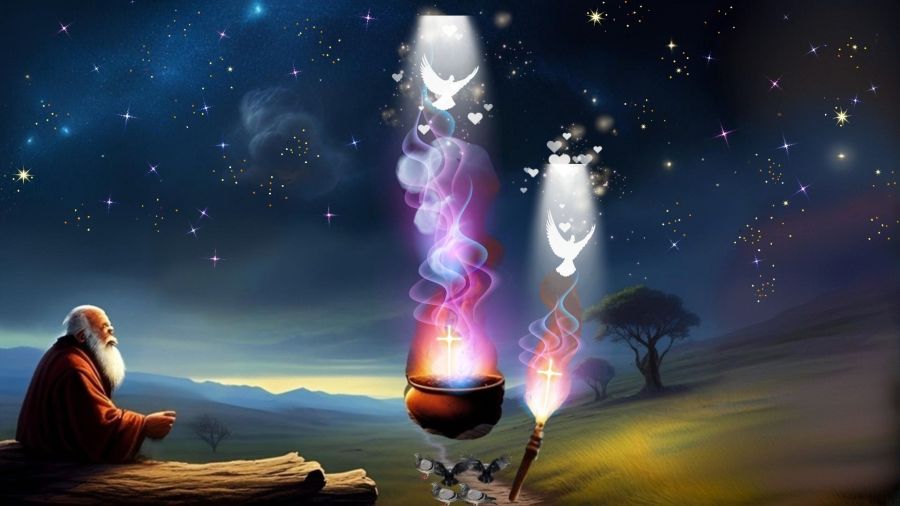
God Walks for Himself and Mankind in Blood Covenant (Crystal A Murray CC BY-NC-SA)
I think the Apostle Paul said it best in Romans 7:15… “I don’t really understand myself, for I want to do what is right, but I don’t do it. Instead, I do what I hate.” (NLT) But, at the same time, Psalm 103:14 reminds us, “For He knows how weak we are; He remembers we are only dust.”(NLT)
So God made us to be like Him, but He also knows that sin is a very real part of us that will keep trying to lead us away from the paths of righteousness. He made a way for us to have our sinful behaviors go to judgment without us, and He had a plan for it years before Calvary. We find that plan in Genesis 15 where God and Abraham carry out the ritual of the blood covenant.
In verse 17, Abraham is still kinda knocked out, and he sees two flames in front of him that walk through the pieces. They are a smoking furnace (or fire pot) and a flaming torch. I don’t know which one represented God, and which one represented mankind, but since the flames walked both directions through the sacrifices, and since God kept Abraham in a temporary sleep, the covenant was completed solely by God. I added the doves, white hearts, and crosses to the images to represent God’s Spirit in both lamps.
God walked through the pieces to represent His promise, and then He walked through the pieces to represent Abraham’s promise. Because He knew man would fail, He prepared to pay for that failure with His own blood. (In Acts 20:28, Paul exhorts the teachers to feed the church of The Lord, which He purchased with His own blood.)
In the covenant (see Jeremiah 34:18), people make promises to each other and walk through the sacrificial pieces to confirm their promises. Whoever breaks that promise must pay with their own blood. You can read the steps Abraham took to prepare the sacrifices for the ritual in verses 9-11. In verse 12, a deep sleep falls on Abraham as God recites His promises to Abraham about His blessings on future generations that would come from him. Abraham’s part is to remain faithful and upright before The Lord and to teach his family to do the same.
There are other teachings suggesting what the events between Abraham and God could have meant, but when I was taught what the blood covenant was, it made perfect sense to see the future act of Christ at Calvary as being planned by a loving and merciful God who knows our form. He has been so good to me (and to many others I know), and I’ve seen His mercy deliver me from failures more times than I can count. To think He was planning it so far in advance just deepens my awe for His grace and mercy. What does it say to you?
We have a long reading today from Genesis 15:7 through Genesis 17:6, and that means it is harder for me to boil it down–especially since it has two important story parts. I will focus this post on the first part, from Chapter 15, where we have a ceremony between God and Abram that most people likely read through without realizing its significance. To understand the importance of this ceremony, I first need to tell you about the meaning of the “Blood Covenant” which is what is being performed here in what is now known as the “Abrahamic Covenant” or “Covenant of the Pieces.” It’s one of my favorite Old Testament stories because it gives us a glimpse into the future promise fulfilled by Jesus.
In a blood covenant, the sacrificial animals are cut in two pieces as a representation of the two parties or sides who are making the covenant. If either party breaks his agreement, the penalty is to pay in blood. At Wikipedia, I found an article explaining biblical covenants, and the writer there states it this way… “Covenants in biblical times were often sealed by severing an animal, with the implication that the party who breaks the covenant will suffer a similar fate. In Hebrew, the verb meaning to seal a covenant translates literally as “to cut”. It is presumed by Jewish scholars that the removal of the foreskin symbolically represents such a sealing of the covenant.”
Now, here’s the understated thing about the covenant that I find very exciting: Each party walks through the pieces to symbolize his own keeping of the promise. This was a covenant between Abram (representing mankind) and God (representing Himself), and we see that before Abram was able to walk through, God put him to sleep. Both a smoking fire pot and a flaming torch appeared in the midst of the pieces, which means that God Himself walked through the pieces as both man and God. By doing this, He promised that He would pay the price in blood if either side of the covenant was violated.
We know that God keeps His promises, but we also know that He understands the ways of man and knew we would not keep ours. That means He planned from way back to shed His own blood. Acts 20:28 says, “Therefore take heed to yourselves and to all the flock, among which the Holy Spirit has made you overseers, to shepherd the church of God which He purchased with His own blood.” (Italics mine.) Also, in 1 John 3:16a, the Bible says we know the love of God because He laid down His own life for us.
This was just a beginning of promises to Abram, who will be renamed to Abraham by the end of today’s reading, but I will cover the rest in a separate post due to the length of today’s post. For now though, it excites me to know that His plans for us–and me–have always been to do whatever it takes to make sure He can spend eternity with those He loves. He does this in spite of our rebellious behaviors and our rejection of Him. I guess that’s why in John 15:13-14, Jesus told the disciples that there is no greater love than that where a person would lay down his life for his friends. And then He called them His friends. Halleluyah! We have been granted the greatest love if only we accept it.
Crystal is, like her name, multi-faceted. She can even write about herself in third person and only feel a little awkward about it. 🙂 She loves to write; she loves kaleidoscopes, fractals, and all things colorful; she loves her husband, her family, and her feline furkids; and mostly she loves Yahveh Almighty, her Creator. She believes her creative mind is in her DNA from Him, and she believes He sees His creations as she sees the images inside a kaleidoscope–all different yet all beautiful and most beautiful when light (His light) shines through them.


 Crystal Writes A Blog
A Covenant Only God Could Keep
We have a long reading today from Genesis 15:7 through Genesis 17:6, and that means it is harder for me to boil it down–especially since it has two important story parts. I will focus this post on the first part, from Chapter 15, where we have a ceremony between God and Abram that most people likely read through without realizing its significance. To understand the importance of this ceremony, I first need to tell you about the meaning of the “Blood Covenant” which is what is being performed here in what is now known as the “Abrahamic Covenant” or “Covenant of the Pieces.” It’s one of my favorite Old Testament stories because it gives us a glimpse into the future promise fulfilled by Jesus.
In a blood covenant, the sacrificial animals are cut in two pieces as a representation of the two parties or sides who are making the covenant. If either party breaks his agreement, the penalty is to pay in blood. At Wikipedia, I found an article explaining biblical covenants, and the writer there states it this way… “Covenants in biblical times were often sealed by severing an animal, with the implication that the party who breaks the covenant will suffer a similar fate. In Hebrew, the verb meaning to seal a covenant translates literally as “to cut”. It is presumed by Jewish scholars that the removal of the foreskin symbolically represents such a sealing of the covenant.”
Now, here’s the understated thing about the covenant that I find very exciting: Each party walks through the pieces to symbolize his own keeping of the promise. This was a covenant between Abram (representing mankind) and God (representing Himself), and we see that before Abram was able to walk through, God put him to sleep. Both a smoking fire pot and a flaming torch appeared in the midst of the pieces, which means that God Himself walked through the pieces as both man and God. By doing this, He promised that He would pay the price in blood if either side of the covenant was violated.
We know that God keeps His promises, but we also know that He understands the ways of man and knew we would not keep ours. That means He planned from way back to shed His own blood. Acts 20:28 says, “Therefore take heed to yourselves and to all the flock, among which the Holy Spirit has made you overseers, to shepherd the church of God which He purchased with His own blood.” (Italics mine.) Also, in 1 John 3:16a, the Bible says we know the love of God because He laid down His own life for us.
This was just a beginning of promises to Abram, who will be renamed to Abraham by the end of today’s reading, but I will cover the rest in a separate post due to the length of today’s post. For now though, it excites me to know that His plans for us–and me–have always been to do whatever it takes to make sure He can spend eternity with those He loves. He does this in spite of our rebellious behaviors and our rejection of Him. I guess that’s why in John 15:13-14, Jesus told the disciples that there is no greater love than that where a person would lay down his life for his friends. And then He called them His friends. Halleluyah! We have been granted the greatest love if only we accept it.
Share this post on:
October 17, 2013 Posted by Crystal A Murray (aka CrystalWriter) | Bible Study, Nonfiction, Torah Commentary | Abrahamic Covenant, Abram, Bible, Bible study, Blood Covenant, broken promise, Complete Jewish Bible, Covenant of the Pieces, Creator, cross, crystalwriter, flaming torch, Genesis, Genesis 15, Genesis 16, Genesis 17, God, God shed His own blood, God's covenant, God's promise, grace, Holy Bible, Lord, love, man, mankind, mercy, Old Testament, planned mercy, promise, sacrifice, Scripture, shedding of blood, smoking fire pot, Torah, Torah commentary, Torah Portions, Torah Reading, Word, Word of God, Word of the Lord, Yahveh, Yahweh | Leave a comment