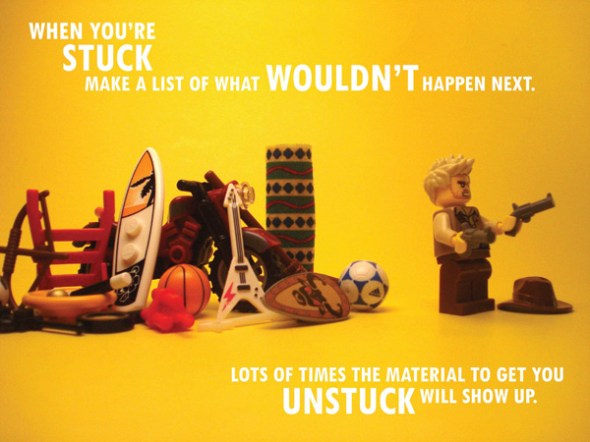
Storytelling Rules of Pixar by Flickr User Alex Eylar, CC License – Attribution, Noncommercial, Share Alike
Click image to open new tab/window to view the original image and to access the user’s photo stream at Flickr, including his images of all the other Pixar rules of storytelling as acted out by Lego figures.
The rule above, and the other Pixar Rules of Storytelling, are great rules of thumb for creating a successful story. Rules, like ingredients in a recipe, are there to make sure that your end result is exactly what you plan from the beginning. A lot of people don’t like rules, but put one of them at a busy intersection with no lights or stop signs, and they’ll wish there were rules to keep everyone from crashing into each other. Many years ago, when Grissom was still a character on CSI, he mentioned that people liked sports because they represented a perfect community; the rules are the same for everyone, and the violations and penalties are acted on swiftly and exactly. Rules bring us peace.
Our newest portion, Parashah 18 is titled Mishpatim which is Hebrew for “rulings.” The full portion runs from Exodus 21:1 through Exodus 24:18, and today’s reading is from Exodus 21:1 through Exodus 21:19. It begins with the sentence, “These are the rulings you are to present to them,” and it goes into the beginnings of the rules Yahveh set forth in order for Israel to live in a peaceful community.
The first set of rules concerns the purchase of Hebrew slaves. I’m not a fan of what we equate with the word slavery, but I feel that if this is something God is governing, anyone who is obedient to Him, is going to treat his slaves as the human beings they are. I believe it is only out of sin that any man has ever treated another man as if he is less than human, whether or not the one doing the mistreatment would call his victims slaves, servants, employees, or any other name. Of course, all these rules follow the 10 Commandments, so if we are loving God first, how we treat others will reflect that.
After the rules about the treatment of slaves, this reading covers the laws that take place when a human hurts another human. It tells what to do when the victim is injured, and when the victim is killed. And it differentiates between the person that is victimized by accident and the one where it was premeditated. Verse 14 is quite strong in that it says if someone kills another person by premeditated planning, they should be taken to their death even if they are at the altar of God.
In these rules, even kidnapping and cursing your parents are causes for death, but fistfighting is apparently not a death penalty unless the person dies. The person who injured another is, however, responsible for caring for the injured person until he recovers. It would be nice if people kept at least that latter rule since it would mean we wouldn’t need all the crazy lawsuits to make it happen.
I’ll close now with a wish that all my readers will keep the law of love as the government over their hearts, so they would not even have to be concerned with these or other rules that come down in Scripture with harsh penalties. And I praise God for the mercy and grace He has given us in sending Yahshua to shed His blood to cover all the rules we do break. Amen.
January 25, 2014
Posted by Crystal A Murray (aka CrystalWriter) |
Bible Study, Nonfiction, Torah Commentary | Adonai, Almighty, Bible, Bible Gateway, Bible reading, Bible study, community, Complete Jewish Bible, Creator, crystalwriter, Exodus, God, Holy Bible, Israel, Lord, Old Covenant, Old Testament, Parashah, peace, Portions, rules. law, Scripture, The Complete Jewish Bible, Torah, Torah commentary, Torah Portions, Torah Reading, Word, Word of God, Word of the Lord, www.biblegateway.com, Yahveh, Yahweh |
Leave a comment


 Crystal Writes A Blog
A Good Rule of Thumb
Storytelling Rules of Pixar by Flickr User Alex Eylar, CC License – Attribution, Noncommercial, Share Alike
Click image to open new tab/window to view the original image and to access the user’s photo stream at Flickr, including his images of all the other Pixar rules of storytelling as acted out by Lego figures.
The rule above, and the other Pixar Rules of Storytelling, are great rules of thumb for creating a successful story. Rules, like ingredients in a recipe, are there to make sure that your end result is exactly what you plan from the beginning. A lot of people don’t like rules, but put one of them at a busy intersection with no lights or stop signs, and they’ll wish there were rules to keep everyone from crashing into each other. Many years ago, when Grissom was still a character on CSI, he mentioned that people liked sports because they represented a perfect community; the rules are the same for everyone, and the violations and penalties are acted on swiftly and exactly. Rules bring us peace.
Our newest portion, Parashah 18 is titled Mishpatim which is Hebrew for “rulings.” The full portion runs from Exodus 21:1 through Exodus 24:18, and today’s reading is from Exodus 21:1 through Exodus 21:19. It begins with the sentence, “These are the rulings you are to present to them,” and it goes into the beginnings of the rules Yahveh set forth in order for Israel to live in a peaceful community.
The first set of rules concerns the purchase of Hebrew slaves. I’m not a fan of what we equate with the word slavery, but I feel that if this is something God is governing, anyone who is obedient to Him, is going to treat his slaves as the human beings they are. I believe it is only out of sin that any man has ever treated another man as if he is less than human, whether or not the one doing the mistreatment would call his victims slaves, servants, employees, or any other name. Of course, all these rules follow the 10 Commandments, so if we are loving God first, how we treat others will reflect that.
After the rules about the treatment of slaves, this reading covers the laws that take place when a human hurts another human. It tells what to do when the victim is injured, and when the victim is killed. And it differentiates between the person that is victimized by accident and the one where it was premeditated. Verse 14 is quite strong in that it says if someone kills another person by premeditated planning, they should be taken to their death even if they are at the altar of God.
In these rules, even kidnapping and cursing your parents are causes for death, but fistfighting is apparently not a death penalty unless the person dies. The person who injured another is, however, responsible for caring for the injured person until he recovers. It would be nice if people kept at least that latter rule since it would mean we wouldn’t need all the crazy lawsuits to make it happen.
I’ll close now with a wish that all my readers will keep the law of love as the government over their hearts, so they would not even have to be concerned with these or other rules that come down in Scripture with harsh penalties. And I praise God for the mercy and grace He has given us in sending Yahshua to shed His blood to cover all the rules we do break. Amen.
Share this post on:
January 25, 2014 Posted by Crystal A Murray (aka CrystalWriter) | Bible Study, Nonfiction, Torah Commentary | Adonai, Almighty, Bible, Bible Gateway, Bible reading, Bible study, community, Complete Jewish Bible, Creator, crystalwriter, Exodus, God, Holy Bible, Israel, Lord, Old Covenant, Old Testament, Parashah, peace, Portions, rules. law, Scripture, The Complete Jewish Bible, Torah, Torah commentary, Torah Portions, Torah Reading, Word, Word of God, Word of the Lord, www.biblegateway.com, Yahveh, Yahweh | Leave a comment