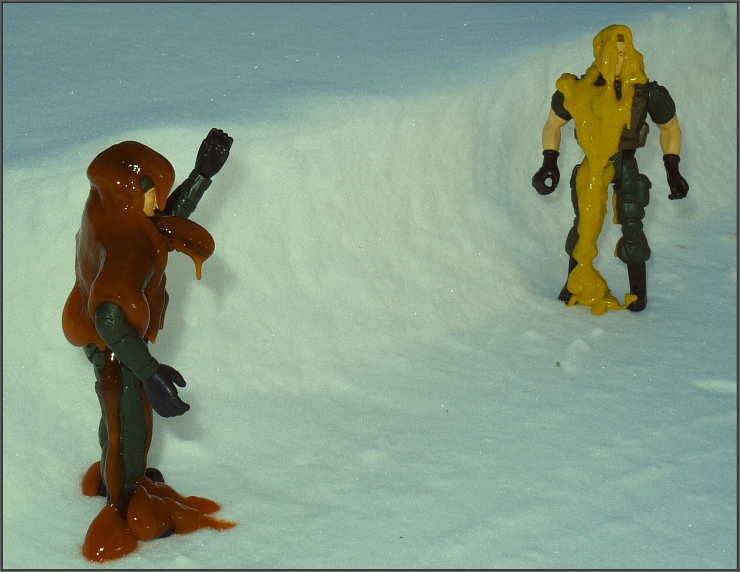
The Condiment War by Flickr User Bill Keaggy, CC License = Attribution, Noncommercial, Share Alike
Click image to open a new tab/window to view the original image and to access the user’s full photo stream at Flickr.
What goes through your mind when you read today’s title? Mustard gas? Food fights? Whatever it is, I’m going to guess it’s not homophones (words that sound alikebut are spelled different and mean different things). But that was the first thing that went through my mind as I read the portion to prepare for tonight’s reading. I’m always on the lookout for more words to add to my list of now over 450 sets of homophones, and I will soon be adding “mustard; mustered” to my list. So now you know that tonight’s post doesn’t have anything to do with mustard the condiment, but I became certain I would use this title when I found the cute image to go with it.
In today’s reading from Numbers 31:1 through Numbers 31:12, God speaks to Moses about the Midianite people. He tells Moses to take vengeance on the Midianites on behalf of Israel, and He tells him that after it is done, Moses will be gathered to his people. At this point, I’m wondering if Moses moved a little more slowly to prepare the troops since it would be his last battle, and he was still concerned about the people. Then again, maybe he moved even more quickly because it would be his last battle, and he looked forward to the relief his death would bring him.
Fast or slow, we don’t know, but we know that Moses obeyed God and gathered the leaders of all the tribes of Israel. Moses told the leaders to equip 1000 men from each tribe for battle, so all together 120,000 men were mustered for war. (Now you see where I got my title. :-)) Moses sent the men out, and along with them, he sent Phinehas, the son of Eleazar the high priest, with holy utensils and with trumpets to sound the alarms.
Israel fought against Midian, as God ordered Moses, and they kills every male. They also killed the five kings of Midian (Evi, Rekem, Zur, Hur, and Reba) along with all the others who were slain. They used a sword to kill Balaam the son of Beor, but there’s nothing in today’s reading that says what happened to Balak. The Israelites then took captive the women of Midian and their little ones, plus they took all their cattle, flocks, and goods as spoils of war. On their way out, they burned all the homes and encampments, and then brought the spoils and captives to Eleazar and the congregation camped on the plains of Moab, by the River Jordan across from Jericho.
I’m not a big fan of war, and if I thought it was possible to live in total peace and not have war at all, I would most certainly be one of the first to protest the idea of war. Unfortunately, I am wise enough to know that some people cannot be stopped except by an act of war. There are people who wage the first wars either blatantly, by doing something like attacking the “twin towers,” and there are those who wage war more silently by kidnapping young girls and using them as sex slaves.
There are many wars against the innocent that too many of us are unaware of, but God is watching them at all times. He knows when people are destroying or damaging that which is made in His image, such as the destruction of innocent babies just because they are too young to speak for themselves. I don’t know what all Midian did against Israel or against God, but it was enough that He both declared war and strengthened soldiers to fight it. He knows what He is doing when it comes to war, so that is why He told us to let Him take vengeance when it is necessary. And, if there comes a time when He wants us to fight, He will give us the instruction, the tools, and maybe even the mustard we need to do it.
July 6, 2014
Posted by Crystal A Murray (aka CrystalWriter) |
Bible Study, Nonfiction, Torah Commentary | battle, Bible Commentary, Bible study, Complete Jewish Bible, Midianites, Moses, Numbers, Scripture, Torah Portions |
Leave a comment


 Crystal Writes A Blog
Mustard for War
The Condiment War by Flickr User Bill Keaggy, CC License = Attribution, Noncommercial, Share Alike
Click image to open a new tab/window to view the original image and to access the user’s full photo stream at Flickr.
What goes through your mind when you read today’s title? Mustard gas? Food fights? Whatever it is, I’m going to guess it’s not homophones (words that sound alikebut are spelled different and mean different things). But that was the first thing that went through my mind as I read the portion to prepare for tonight’s reading. I’m always on the lookout for more words to add to my list of now over 450 sets of homophones, and I will soon be adding “mustard; mustered” to my list. So now you know that tonight’s post doesn’t have anything to do with mustard the condiment, but I became certain I would use this title when I found the cute image to go with it.
In today’s reading from Numbers 31:1 through Numbers 31:12, God speaks to Moses about the Midianite people. He tells Moses to take vengeance on the Midianites on behalf of Israel, and He tells him that after it is done, Moses will be gathered to his people. At this point, I’m wondering if Moses moved a little more slowly to prepare the troops since it would be his last battle, and he was still concerned about the people. Then again, maybe he moved even more quickly because it would be his last battle, and he looked forward to the relief his death would bring him.
Fast or slow, we don’t know, but we know that Moses obeyed God and gathered the leaders of all the tribes of Israel. Moses told the leaders to equip 1000 men from each tribe for battle, so all together 120,000 men were mustered for war. (Now you see where I got my title. :-)) Moses sent the men out, and along with them, he sent Phinehas, the son of Eleazar the high priest, with holy utensils and with trumpets to sound the alarms.
Israel fought against Midian, as God ordered Moses, and they kills every male. They also killed the five kings of Midian (Evi, Rekem, Zur, Hur, and Reba) along with all the others who were slain. They used a sword to kill Balaam the son of Beor, but there’s nothing in today’s reading that says what happened to Balak. The Israelites then took captive the women of Midian and their little ones, plus they took all their cattle, flocks, and goods as spoils of war. On their way out, they burned all the homes and encampments, and then brought the spoils and captives to Eleazar and the congregation camped on the plains of Moab, by the River Jordan across from Jericho.
I’m not a big fan of war, and if I thought it was possible to live in total peace and not have war at all, I would most certainly be one of the first to protest the idea of war. Unfortunately, I am wise enough to know that some people cannot be stopped except by an act of war. There are people who wage the first wars either blatantly, by doing something like attacking the “twin towers,” and there are those who wage war more silently by kidnapping young girls and using them as sex slaves.
There are many wars against the innocent that too many of us are unaware of, but God is watching them at all times. He knows when people are destroying or damaging that which is made in His image, such as the destruction of innocent babies just because they are too young to speak for themselves. I don’t know what all Midian did against Israel or against God, but it was enough that He both declared war and strengthened soldiers to fight it. He knows what He is doing when it comes to war, so that is why He told us to let Him take vengeance when it is necessary. And, if there comes a time when He wants us to fight, He will give us the instruction, the tools, and maybe even the mustard we need to do it.
Share this post on:
July 6, 2014 Posted by Crystal A Murray (aka CrystalWriter) | Bible Study, Nonfiction, Torah Commentary | battle, Bible Commentary, Bible study, Complete Jewish Bible, Midianites, Moses, Numbers, Scripture, Torah Portions | Leave a comment