Jingle Bells
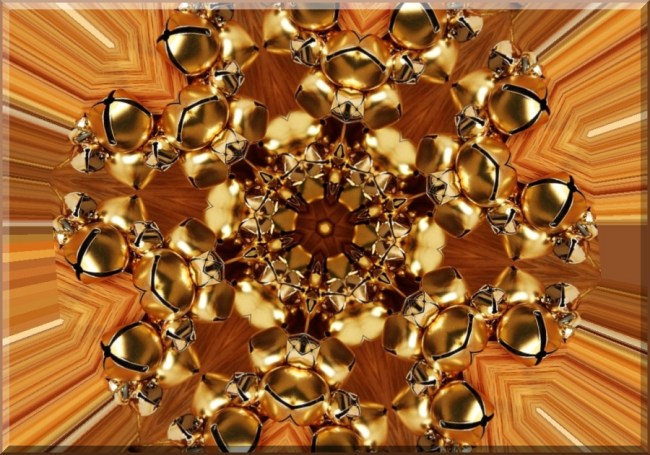
Golden Jingle Bells Kaleidoscope by Crystal A Murray, CC License = Attribution, Noncommercial, Share Alike
Click image to open new tab/window to view my original image and to access my full photo stream at Flickr. There are other kaleidoscopes from the bells, and you can find the link to the original image from which this design was made.
I was looking for something with a picture of bells when I came across the above image from a challenge I had while in a digital kaleidoscope creation group back in 2008. I was torn between using an image and a song title, so in my search, I also discovered that there are a lot of songs out there with lyrics or titles about bells. So, just for fun I thought I’d ask, how many songs can you name that are about bells or have bells in the title? Here are some to get you started…
- Jingle Bells
- You can Ring My Bell
- If I Had a Hammer (verse 3: If I had a bell to ring)
- I Heard the Bells on Christmas Day
- Ding Dong, Ding Dong, Christmas Bells Are Ringing
- Let ‘Em In (Somebody’s knocking on the door, somebody’s ringin’ the bell)
- Ding Dong, the Witch is Dead
- Silver Bells
- When They Ring Those Golden Bells
And the last one I’ve listed is the perfect segue into today’s reading from Exodus 28:31 through Exodus 28:43, the end of the chapter. The details for adorning the priest are now up to the blue robe that the priest will wear under the ritual vest. On the hem of the robe, the artisans are instructed to add blue, purple, and scarlet pomegranates with golden bells between each of them. The bells will ring continually while the priest walks around and ministers in the Holy Place, so the people will know He has not gone into the presence of Yahveh with a sinful heart and collapsed in death.
So now my mind is all over the map with trying to figure out if the bells signified anything else besides the evidence of life. I know from a tour of The Tabernacle Experience when it was in Louisville that on the highest holy day, Yom Kippur, the people knew the importance of their sins being pushed forward a year, so they waited quietly, listening for the priests bells to make sure nothing interrupted this important part of his ministry. But, I also wonder if the bells were a type of music to God. Did He long for the sound of the bells that said one of His priests was about to enter His presence? Did He rejoice with the music of the bells as the priest went out to announce to the people the good news that their sins were forgiven for another year? Interesting things to think about, huh?
In addition to the adorned robe and vest, the priest is to wear a linen turban that includes a golden seal engraved with the words, “Set Apart for Adonai.” This reminder is needed because the high priest, Aaron at the time, goes in bearing the guilt of the people who have erred from God’s commands. It is both a blessing and a grave thing to be set apart for the Lord. It is a blessing because to be set apart means to be holy in God’s eyes. And it is a grave thing because, for the high priest, it meant he carried a very heavy burden until it was hoisted upon the altar. For our final High Priest, Yahshua our Messiah, it was a blessing to come to this earth holy enough to bear the weight of our sins permanently, but it was also said to be a curse to die upon a cross as He had to do to free of from our sin.
The priests were also to wear woven tunics and colorful belts to hold everything in place. And while I haven’t checked it piece by piece yet, I think there’s a connection to all these priestly vestments and the whole armor of God. Be my guest and see what you can come up with, and add your notes to the comments section.
Finally, the last paragraph talks about what I think is the very first pair of underwear. With both pomegranates and underwear in the same story, I momentarily thought of using the title “Fruit of the Loom,” but I decided against it because of the holiness that all the priests vestments represent. In this case, God tells Moses that the men are to wear linen shorts that they will not be found guilty in His presence, and so they will not die.
I am amazed at how God covered, literally, every part of the human form that our humanity and sin could be covered to allow for ministry and sacrifice. He desired to be connected to us so much that when these artistic coverings and the blood of bulls and goats were still not enough, He created a priest’s garment made of flesh and robed His Spirit head to toe to give us His life in our place. While He was still walking in that flesh, He stated that there was no greater love than that of one who would lay down his life for a friend. His word tells us that we are not just His flock as the people were like flocks for Aaron and other priests, but we were also Christ’s friends. Truly, there never has been, and never will be, a greater love.
Share this post on:

My Latest Flickr Photos


Others’ Posts I’ve Liked


 Crystal Writes A Blog
A Vested Interest in Israel
Cute Vests by Flickr User TheUglySweaterShop, CC License = Attribution
Click image to open new tab/window to view original image and to access user’s full photo stream at Flickr.
I love when a title can be seen in multiple ways, and even more when all the ways can be true. Based on the definitions of the word vest, it can be a garment worn to the waist, and the priest in the camp of Israel will wear the garment. It means to bestow power or authority on someone, and God definitely bestowed a lot on the priests of the tribe of Levi. And, it can mean to have a personal stake in something or someone. Both God and the priests have a vested interest in Israel and in the mercy and grace that are represented by the priesthood and the tabernacle practices.
In today’s reading from Exodus 39:2 through Exodus 39:21, we get to see the details of the vest that the artisans are making for the high priest. The parts of the vest, such as the breastplate, are made from gold; blue, purple, and scarlet yarn; and finely-woven linen. And, yes, the first item in that list is actually gold, not just gold yarn. The reading says that they hammered the gold into thin sheets and then cut the sheets into threads in order to work them into the yarns and linen.
Can you imagine gold thread that is actually made from gold? Elvis Presley could imagine something close since he had a famous suit made from gold lame’ which was a yarn made with metallic ingredients. A famous tailor to the stars named Nudie Cohn created that suit, and many other famously outrageous outfits. You can read about him at Wikipedia, but since there are no pictures, I found a Pinterest page with lots of fun images, including Elvis’ suit and Nudie’s famous car. I actually got to see the car in person when I was a little girl living in Southern California. There were coins in the dashboard, the doors opened by pulling triggers on pistols, and there was a huge set of bull horns on the front of the car.
So, getting back to the original celebrity designer, God issued detailed instructions for the designs that would cover the priests in His service, and then He anointed skilled men to create them. He did all of this to represent the value of Israel to Him since the high priest was a representation of God Himself. And the part I find the most moving in this story is that God wanted the breastplate fastened down with gold chains, so it would ALWAYS be over the heart of the priest. Need I say more?
Share this post on:
February 26, 2014 Posted by Crystal A Murray (aka CrystalWriter) | Bible Study, Nonfiction, Torah Commentary | Adonai, Almighty, Bible, Bible Gateway, Bible reading, Bible study, Complete Jewish Bible, craftsmen, Creator, crystalwriter, design, Exodus, garments, God, gold suit, high priest, Holy Bible, Israel, Lord, Nudie Cohn, obedience, Old Covenant, Old Testament, Parashah, Portions, priest, ritual vest, Scripture, tabernacle, The Complete Jewish Bible, Torah, Torah commentary, Torah Portions, Torah Reading, vest, vestments, Word, Word of God, Word of the Lord, www.biblegateway.com, Yahveh, Yahweh | Leave a comment