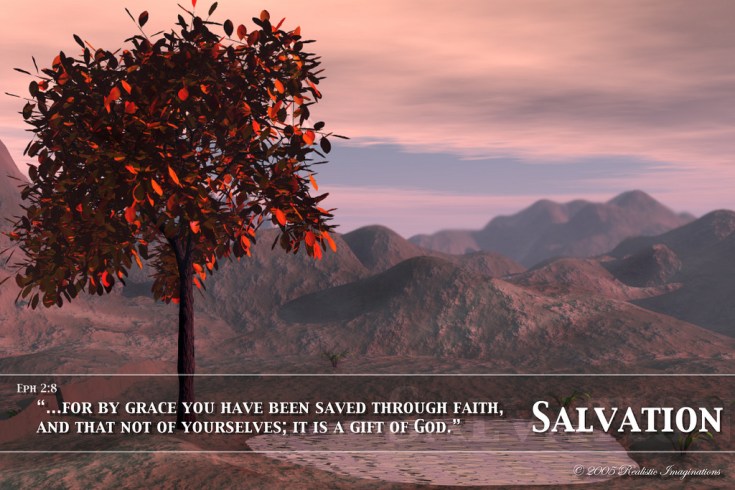
Salvation Poster by Flickr User Realistic Imaginations, CC License = Attribution, Noncommercial, No Derivative Works
Click image to open new tab/window to view original image and to access user’s full photo stream at Flickr.
If I were to ask you if you honor the Lord with holiness, you would likely begin to look at the works you do for Him to decide how to answer. But I believe holiness has everything to do with our hearts, and only has to do with our works insomuch as they follow the thoughts of our hearts. Holiness begins in our hearts and with a commitment to give to God that which He should have because He is worthy. Holiness is the change of heart that makes us see God as worthy of our belief, our obedience, our trust, and our praise.
In today’s reading from Leviticus 21:16 through Leviticus 22:16, we start with Yahveh telling Moses to tell Aaron the following: “None of your descendants who has a defect may approach to offer the bread of his God.” And then the teaching goes on to explain all the types of defects that would prevent a descendant of Aaron from working in the priesthood. I would not be able to bring offerings into the holy place because I have stunted growth. My husband could not bring offerings into the holy place because he has a cataract. We could both eat the bread of God, both the holy and the especially holy, but we could not offer it to God with our defects because that would profane God and His place of holiness.
Moses tells these things to Aaron and to all of Israel, and then he goes to Aaron to deepen the lesson. He tells him to have his sons keep themselves separate from the holy things of God, so they will not take a chance of defiling them by approaching them in an unholy state. If they do, God will cut them off from their people. For us, this means that we should not try to come into “the church” by doing all the right stuff without first repenting and being covered with the holy blood of Christ to make us clean. Like the verse above says, our salvation is a gift from God, and that alone should be enough to bring us to our knees before we strap on the apron of good works.
The teaching goes on to explain more ways in which a descendant from Aaron (member of the tribe of Levi) can make himself or herself unclean, and that uncleanness can prevent both doing the work of the tabernacle and partaking of the holy food. Even a daughter who has married outside of the tribe is no longer able to partake of the food, but a widow or divorcee with no child that comes back to live with her father may share in the food. Also, while an employee or tenant may not partake of the holy foods, a slave that lives in the home of a Levite may eat them.
I see all of this teaching as a simple commandment to not put the cart before the horse. We don’t do the works of God with unholy hearts that are not committed to Him. That means we don’t get brownie points for going to church on Sundays and hoping it will erase the demerits we earned during the rest of the week. We don’t get a pat on the back from God because we donate to good causes or give ourselves to service if we are doing those things in the sin of pride and arrogance instead of with a holy love for our Creator.
Holiness is a changed state of heart and mind that will have us proclaiming the glory of God in wondrous new ways. Here are just some of the verses from King David’s song in Psalm 96 in which I can see his holy heart…
1Oh, sing to the Lord a new song!
Sing to the Lord, all the earth.
2 Sing to the Lord, bless His name;
Proclaim the good news of His salvation from day to day.
3 Declare His glory among the nations,
His wonders among all peoples.
4 For the Lord is great and greatly to be praised…
6 Honor and majesty are before Him;
Strength and beauty are in His sanctuary.
9 Oh, worship the Lord in the beauty of holiness!
Tremble before Him, all the earth.
I especially like that last verse because I see holiness as something beautiful and wonderful. It is an acknowledgement that God’s holiness is so majestic that all we can do is tremble in His holy presence. Hallelu-Yah!
April 20, 2014
Posted by Crystal A Murray (aka CrystalWriter) |
Bible Study, Nonfiction, Torah Commentary | Aaron, Adonai, Almighty, Bible, Bible Gateway, Bible reading, Bible study, clean, Complete Jewish Bible, Creator, crystalwriter, God, holiness, Holy Bible, Israel, Leviticus, Lord, Moses, obedience, Old Covenant, Old Testament, Parashah, Portions, priests, Scripture, The Complete Jewish Bible, Torah, Torah commentary, Torah Portions, Torah Reading, unclean, Word, Word of God, Word of the Lord, works, www.biblegateway.com, Yahveh, Yahweh |
Leave a comment


 Crystal Writes A Blog
First Holiness, Then Good Works
Salvation Poster by Flickr User Realistic Imaginations, CC License = Attribution, Noncommercial, No Derivative Works
Click image to open new tab/window to view original image and to access user’s full photo stream at Flickr.
If I were to ask you if you honor the Lord with holiness, you would likely begin to look at the works you do for Him to decide how to answer. But I believe holiness has everything to do with our hearts, and only has to do with our works insomuch as they follow the thoughts of our hearts. Holiness begins in our hearts and with a commitment to give to God that which He should have because He is worthy. Holiness is the change of heart that makes us see God as worthy of our belief, our obedience, our trust, and our praise.
In today’s reading from Leviticus 21:16 through Leviticus 22:16, we start with Yahveh telling Moses to tell Aaron the following: “None of your descendants who has a defect may approach to offer the bread of his God.” And then the teaching goes on to explain all the types of defects that would prevent a descendant of Aaron from working in the priesthood. I would not be able to bring offerings into the holy place because I have stunted growth. My husband could not bring offerings into the holy place because he has a cataract. We could both eat the bread of God, both the holy and the especially holy, but we could not offer it to God with our defects because that would profane God and His place of holiness.
Moses tells these things to Aaron and to all of Israel, and then he goes to Aaron to deepen the lesson. He tells him to have his sons keep themselves separate from the holy things of God, so they will not take a chance of defiling them by approaching them in an unholy state. If they do, God will cut them off from their people. For us, this means that we should not try to come into “the church” by doing all the right stuff without first repenting and being covered with the holy blood of Christ to make us clean. Like the verse above says, our salvation is a gift from God, and that alone should be enough to bring us to our knees before we strap on the apron of good works.
The teaching goes on to explain more ways in which a descendant from Aaron (member of the tribe of Levi) can make himself or herself unclean, and that uncleanness can prevent both doing the work of the tabernacle and partaking of the holy food. Even a daughter who has married outside of the tribe is no longer able to partake of the food, but a widow or divorcee with no child that comes back to live with her father may share in the food. Also, while an employee or tenant may not partake of the holy foods, a slave that lives in the home of a Levite may eat them.
I see all of this teaching as a simple commandment to not put the cart before the horse. We don’t do the works of God with unholy hearts that are not committed to Him. That means we don’t get brownie points for going to church on Sundays and hoping it will erase the demerits we earned during the rest of the week. We don’t get a pat on the back from God because we donate to good causes or give ourselves to service if we are doing those things in the sin of pride and arrogance instead of with a holy love for our Creator.
Holiness is a changed state of heart and mind that will have us proclaiming the glory of God in wondrous new ways. Here are just some of the verses from King David’s song in Psalm 96 in which I can see his holy heart…
I especially like that last verse because I see holiness as something beautiful and wonderful. It is an acknowledgement that God’s holiness is so majestic that all we can do is tremble in His holy presence. Hallelu-Yah!
Share this post on:
April 20, 2014 Posted by Crystal A Murray (aka CrystalWriter) | Bible Study, Nonfiction, Torah Commentary | Aaron, Adonai, Almighty, Bible, Bible Gateway, Bible reading, Bible study, clean, Complete Jewish Bible, Creator, crystalwriter, God, holiness, Holy Bible, Israel, Leviticus, Lord, Moses, obedience, Old Covenant, Old Testament, Parashah, Portions, priests, Scripture, The Complete Jewish Bible, Torah, Torah commentary, Torah Portions, Torah Reading, unclean, Word, Word of God, Word of the Lord, works, www.biblegateway.com, Yahveh, Yahweh | Leave a comment